




First-year finance calendar for a funded startup
Everything on the company calendar, plus the dates that arrive with DPIIT recognition, funding rounds, ESOPs and investors.
Pick the one that matches the entity
A funded startup runs two calendars at once: the statutory one every company has, and the one its investors set. The statutory dates are below. The investor dates, monthly numbers, quarterly board packs and diligence before every round, are contractual, and they reward a finance function set up early. A data room is a download only if the books were kept as if someone would read them.
Dates that start when something happens
Incorporation, the first hire, the first invoice, an allotment. These are the ones nobody’s diary reminds them of.
Companies Act
First board meeting; appointment of the first auditor by the board (failing which the members appoint within 90 days at an EGM); registered-office verification (INC-22) if not filed at incorporation; opening of the current account
Companies Act
Share certificates issued to subscribers; subscription money received into the company’s account
Companies Act
INC-20A declaration of commencement of business. No borrowing or business before it; late filing carries fees and the risk of strike-off
GST
GST registration (mandatory from ₹40 lakh of goods turnover or ₹20 lakh of services in most states; immediately for inter-state supply of goods, e-commerce sellers and reverse-charge cases; lower thresholds in special-category states)
Income tax
TAN is allotted with incorporation; TDS deducted from the first contractor, professional, rent or salary payment above threshold and deposited by the 7th
EPFO / ESIC / State
PF registration and ESI registration; voluntary PF earlier is possible; state Shops & Establishments registration and professional-tax registration on the first hire in most states
Companies Act / FEMA
PAS-3 return of allotment (and FC-GPR within 30 days where the allottee is a foreign investor)
Companies Act
CHG-1 registration of the charge when the company takes a secured loan
Companies Act
At least four board meetings with no more than 120 days between two (small companies: two meetings, one in each half); statutory registers maintained; minutes signed within 30 days
DPIIT
DPIIT recognition through the Startup India portal. It is the gateway to the tax holiday application, self-certification under labour and environment laws, and several government programmes
Income tax
Application to the Inter-Ministerial Board for the three-year profit-linked deduction available to eligible recognised startups incorporated within the qualifying window; the books must already be clean
Companies Act / Income tax
Valuation report (registered valuer under the Companies Act; income-tax pricing rules for the premium); board and members’ resolutions; offer letter (PAS-4) for a private placement; a separate bank account for the money until allotment
Companies Act / FEMA
PAS-3 return of allotment; share certificates within two months; FC-GPR within 30 days where the investor is foreign; MGT-14 for the special resolution within 30 days
Companies Act / Income tax
ESOP scheme approved by special resolution and filed in MGT-14; grant letters; a register of options; perquisite tax on exercise reported through payroll (deferred for eligible recognised startups)
Companies Act
SH-7 within 30 days with stamp duty and ROC fees
Investors
Monthly or quarterly investor update, cap table reconciled to filings, data room kept current. A contractual date, not a statutory one, and the one that most often costs founders a follow-on
The monthly rhythm
The same six dates every month. Penalties on these compound, so they are the first thing Finac automates for a new client.
The year, month by month
Dates follow the notifications in force on 24 September 2026 and the standard monthly filing cycle unless stated. States set their own professional-tax and shops and establishments dates.
April 2026
May 2026
June 2026
July 2026
August 2026
September 2026
October 2026
November 2026
December 2026
January 2027
February 2027
March 2027
A calendar is only useful if someone owns every line
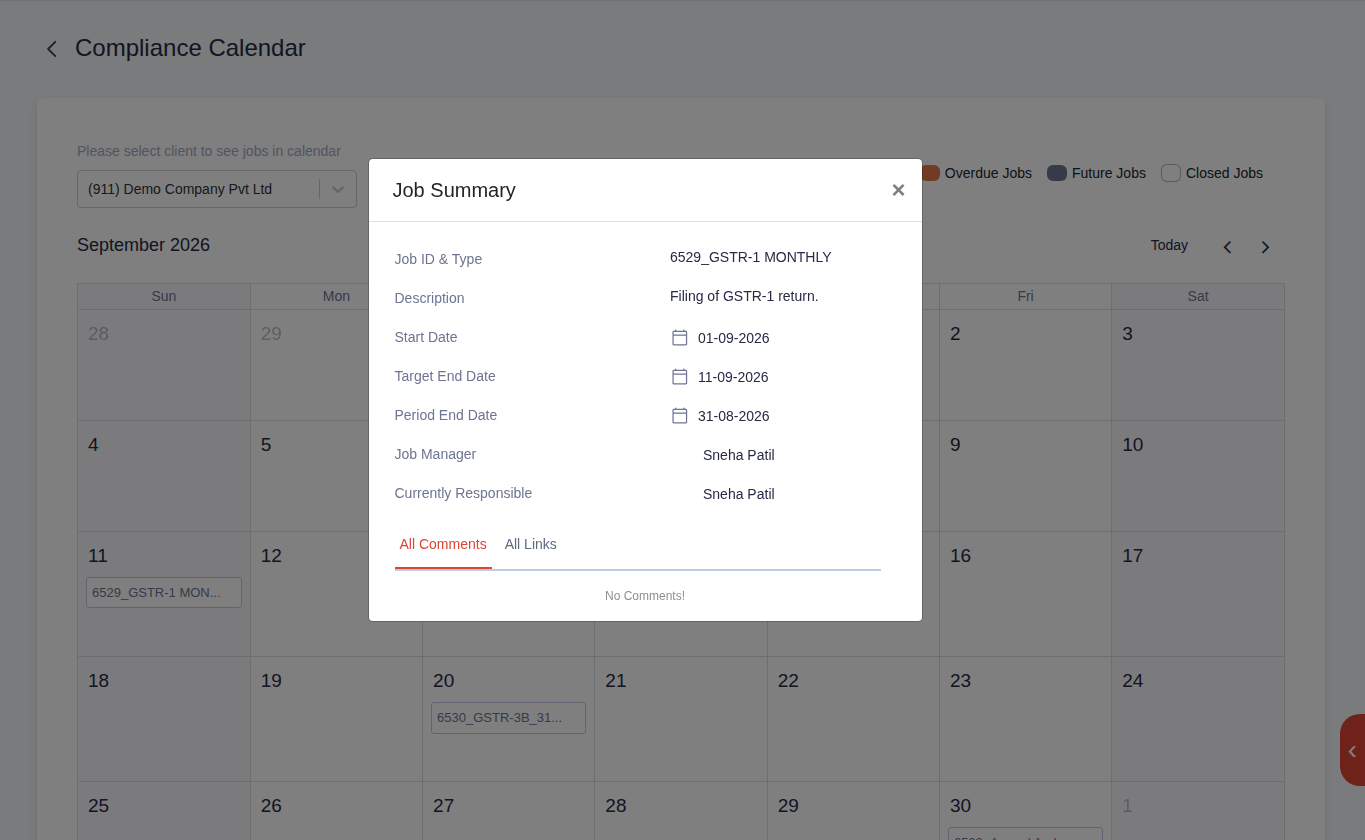
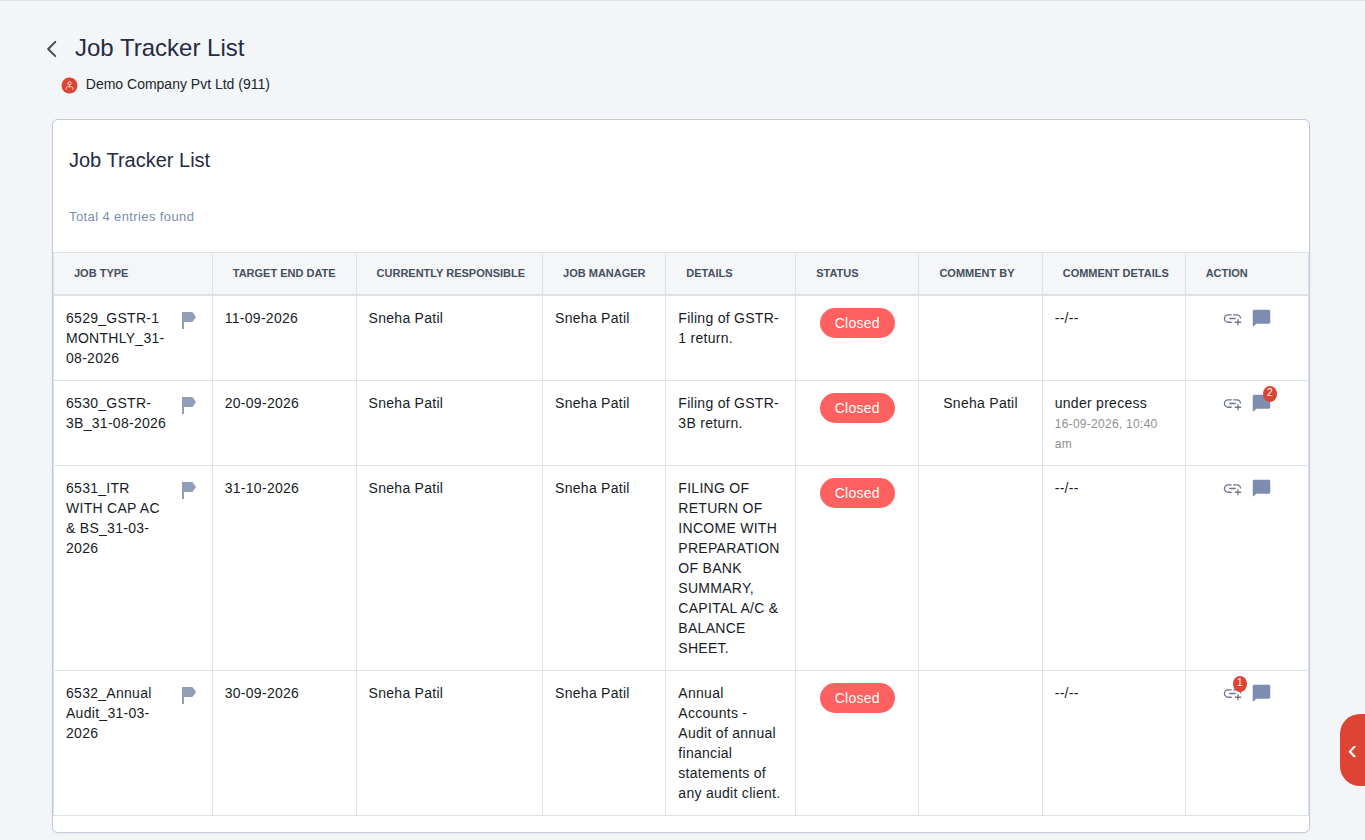
Each filing on this page is tracked for every client: a start date, a target date, a person responsible and the filed acknowledgement attached. You see the same calendar we do. Nothing depends on a reminder in someone’s inbox.
- State-specific professional tax and shops and establishments dates added per client
- QRMP or monthly GST cycle set at onboarding
- Reviewed every quarter against new notifications
- Engagements from ₹6,999 a month, scoped to the business


Frequently asked
Which dates change if the business is on the QRMP scheme?
GSTR-1 becomes quarterly, by the 13th of the month after the quarter, with an optional invoice furnishing facility by the 13th in months one and two. GSTR-3B becomes quarterly, by the 22nd or 24th after the quarter depending on the state, with tax paid monthly through PMT-06 by the 25th.
What happens if INC-20A is filed late?
Additional fees apply, the company cannot commence business or borrow until it is filed, and the Registrar may start strike-off proceedings after 180 days.
Have the form numbers changed under the Income-tax Act 2025?
Yes. The Income-tax Rules 2026, in force from 1 April 2026, renumbered most forms. Form 130 replaces Form 16, Form 138 replaces 24Q, Form 140 replaces 26Q, Form 26 replaces the tax audit forms 3CB and 3CD, and Form 48 replaces 3CEB. This calendar uses the new numbers and gives the old ones alongside.
Does Finac handle these dates for its clients?
Yes. Every filing on this page is tracked for each client, with an owner, a target date and the filed document attached. You see the same calendar we do. Engagements start at ₹6,999 a month and are scoped to the business.
Would you rather someone handled these dates for you?
Eighteen questions, two minutes, and you see what Finac would cost your business. Finac engagements start at ₹6,999 a month and rise with the work.
Finac is the outsourced finance department for growing Indian businesses, run by AKSSAI ProjExel Private Limited, a professional services firm of qualified accountants, tax and compliance specialists, many of whom have worked at MNCs and Big Four firms. Our teams work from Bangalore, Jaipur, Noida, Jabalpur, Bhopal and Indore, and we serve clients in the USA, UK, Taiwan and Australia remotely. Fees exclude GST. This calendar is a summary of the rules and notifications in force on the review date; form numbers follow the Income-tax Rules 2026 with the earlier numbers alongside. Screens shown are from a demonstration company on the Finac platform. Reviewed 24 September 2026.